Showing posts with label Immigration. Show all posts

Tuesday, July 01, 2014

Immigration – Filling the Void


July 1, 2014
Bryan Baumgart
Chairman, Douglas County Republican Party


The United States is not alone in its struggles to replace an aging workforce and the important tax revenue attached to it.  As America continues to “gray”, it must find a way to care for its aging population.  While other countries such as Japan and China struggle to find a solution (see charts below), the United States has a distinct advantage in that immigrants continue to flock to this country seeking freedom and opportunity.  
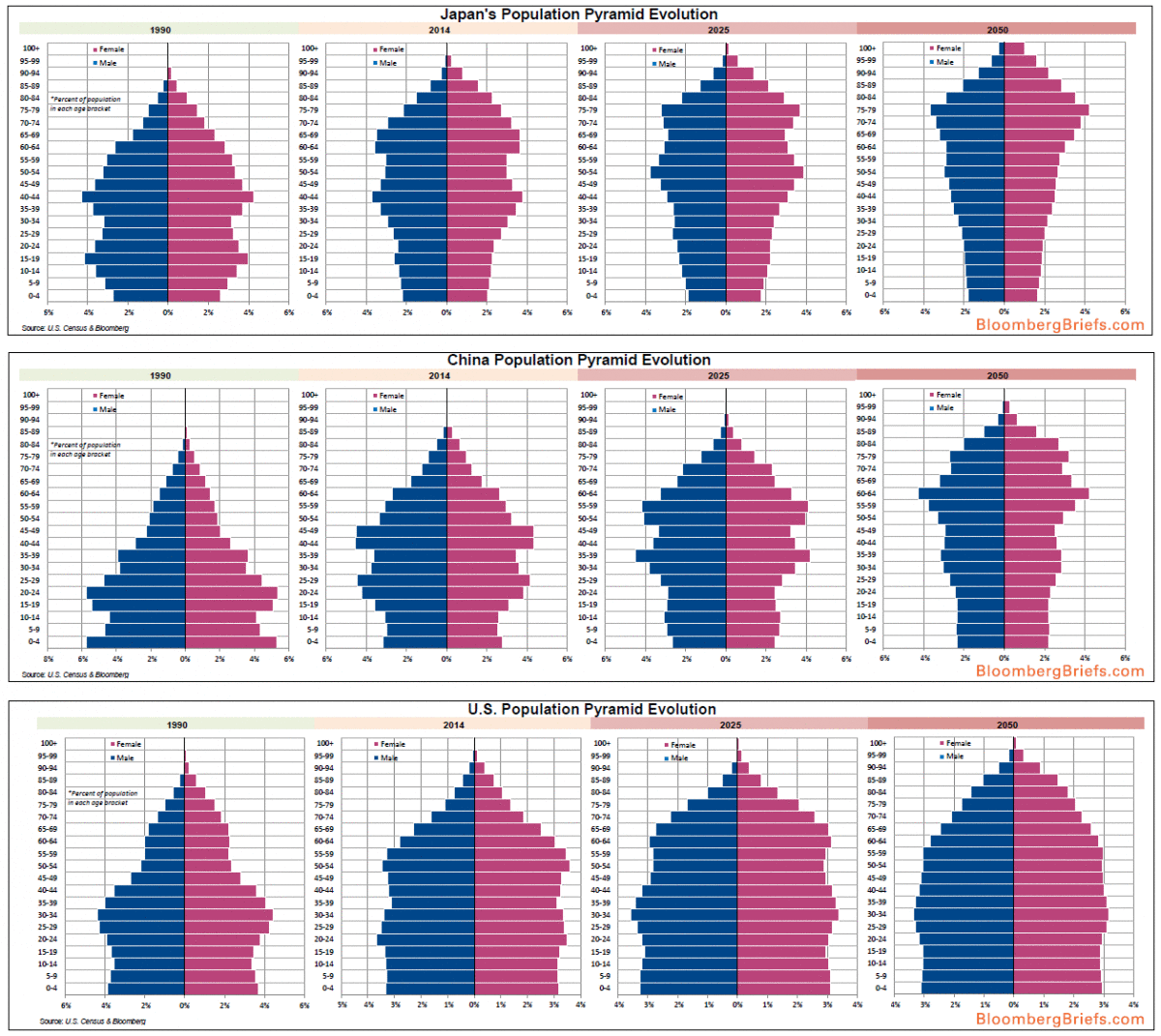

 
The facts are undeniable. Our country is quickly sinking in debt, Social Security and Medicare are rapidly approaching insolvency, and the ever increasing number of laborers leaving the work force only compounds the problem our country is facing. A healthy immigration policy is key, not only to fill the labor demands of American businesses, but to effectively care for our aging population. 

“Neither Medicare nor Social Security can sustain projected long-run programs in full under currently scheduled financing. Both programs will experience cost growth substantially in excess of GDP growth through the mid-2030s due to rapid population aging caused by the large baby-boom generation entering retirement and lower-birth-rate generations entering employment and, in the case of Medicare, to growth in expenditures per beneficiary exceeding growth in per capita GDP.”

Because US birth rates are not sufficient to fill the void left by an aging American workforce, immigration reform with an emphasis on targeted immigration continues to be our best viable solution. Targeted immigration provides a fighting chance for both Social Security and Medicare by filling in the voids of the population pyramid (see below).

 
The follies of failing on immigration reform
An aging workforce is not the only increasing burden American taxpayers must confront.  Our current immigration policy has led to an estimated 14 million plus undocumented immigrants currently residing in the United States, often living at the expense of American taxpayers.

A recent story in the Washington Post explored the burden placed on school budgets by the rising percentage of students who qualify for subsidized meals and extra English instruction:

“Immigration reform could help families more easily attain legal status and begin adding to the tax base.”


Some of the most vocal opponents of immigration reform decry propping up benefits for noncitizens at taxpayer expense. Ironically, these same critics then turn around and oppose allowing their participation in the system.

The undeniable facts remain. Our current immigration process has left us with 14 million undocumented immigrants. Most of which are hardworking, law abiding, family and faith oriented individuals who came seeking the same opportunity and pursuing the same happiness that our ancestors sought. Their children, born in America know no other country or way of life. 
Logic tells us that deportation is not an option, nor should it be. Past attempts to solve the problem through amnesty have obviously failed. Construction of a border fence will certainly prove futile as the human spirit cannot be held captive by a fence or means of force. Immigrants will continue to flock to this country seeking freedom and opportunity with the same furor that drove our ancestors to risk all in the pursuit of a better future.

The solution is to address the failing immigration policy that has caused this problem in the first place. The legal process must first be simplified in order to act as an incentive rather than a deterrent. Once effective reform of the legal process is achieved, undocumented immigrants should be allowed to self-report and enter into that legal process…AT THE BACK OF THE LINE. Temporary citizenship should be granted during this time in order to avoid tearing families apart and other unnecessary societal distress. Rather than living at the expense of American taxpayers, immigrants would be welcomed out of the shadows and could pull their own weight becoming contributing taxpayers themselves.  Immigration should then be targeted at filling the labor demands of American businesses. It’s a problem with a rare win/win solution.

 * I’d like to congratulate my friend Yeny Curruchich Martinez who after a long journey, today became a proud American citizen. Your story which began in Guatemala, led through California, and finally brought you to Nebraska where you passionately serve fellow Nebraskans as a nurse does not end here. Today marks an exciting new chapter in your story.  A story that serves as an inspiration to me. You truly embolden everything that makes America “that shining city on the hill”.  


Tuesday, July 02, 2013

Increasing Legal Immigration is the Answer


This afternoon the Senate voted 68-32 to pass its sweeping immigration reform bill. The bill is a solid improvement over the current immigration system. It legalizes most of the unlawful immigrants here and provides larger pathways for legal immigration in the future.
Under today’s immigration rules, very few of our ancestors would have been able to immigrate here legally. 
The bill does have flaws – many of which I’ve written about in detail. It doesn’t increase lawful immigration enough. The guest worker visa programs for lower skilled workers are too small, restricted to certain sectors of the economy, and governed by confusing bureaucracy. Under today’s immigration rules, very few of our ancestors would have been able to immigrate here legally. The Senate’s immigration bill takes us a small step closer to our traditionally more open immigration policy.

It shovels gargantuan amounts of security resources toward the southern border in an attempt to halt future unlawful immigration that could otherwise cheaply be halted with an expanded guest worker visa program. The border “surge,” as many are calling it, is truly embarrassing, especially for a country with such proud immigrant traditions. There are certainly legitimate security concerns, but the extra enforcement will just drive up the price of smuggling and marginally decrease unlawful immigration of peaceful workers at enormous cost.

Worse, the bill creates a mandatory employment verification system called E-Verify. Those seeking work here will have to use this proto-national ID system to ask the government for permission to work. Government audits of the system find that its inaccuracy rate hovers at around a quarter of a percent. Independent audits, the most recent carried out in 2009, found error rates 3 to 4 times as high as that. As the system is expanded it will place an unfair burden on American businesses, saddling them with costs, and incentivizing illegal hiring without even a cursory I-9 form as has happened in states that have already mandated E-Verify.

Even with those flaws, this bill still does a lot more good than bad. Millions of new Americans will finally be able to live and work openly without fear of deportation. Millions of more highly skilled workers, merit-based immigrants, and their families will be able to become Americans. Americans will have more freedom to hire whom they want and more buyers for their goods and services. Our economy will grow more quickly, wages will increase, and the fiscal state of the federal government will improve over the medium-term.

Despite all of these benefits, this bill will face an uphill battle in the House of Representatives. The first round of a major political brawl has been concluded; time for the toughest round to begin.


http://www.cato.org/blog/immigration-bill-better-not-best?utm_content=bufferb6f2c&utm_source=buffer&utm_medium=twitter&utm_campaign=Buffer

Monday, June 17, 2013

Step-By-Step Immigration Reform

By Bryan Baumgart-Douglas County Republican Party Chairman

6/17/2013

Critics of immigration reform call for securing our borders first, but with effective reform, securing our borders on the basis of immigration isn’t necessary.

Rather than a comprehensive approach, I prefer a step-by-step approach to reform with an emphasis on “risk verse reward”…or as we like to call it in the field of behavior modification…“Principles of Behavior”. Our solutions should be incentive based.

First let’s analyse what is driving current behavior.  What is the incentive to bypass the legal immigration process?  As we know, the current system is extremely convoluted and expensive. It takes far too long and is rife with unintended consequences.

For example, a friend and former co-worker of mine from Brazil had spent years and thousands of dollars working through the system. When he was approached with an outstanding job opportunity with a different company, he was faced with the decision of turning down the offer or starting the immigration process all over again. In the end, he felt like it was just too much time and money to throw away. He was left stuck, extremely frustrated, and he lost out on a great opportunity to advance his career.

The first step in effective reform must be simplifying the legal immigration process. This is likely the most difficult step, but a legal immigration process that is affordable, timely, and efficient serves as an incentive rather than a deterrent.

The next question is what becomes of the 11 million undocumented immigrants currently in our country? Critics decry amnesty, but deportation is not a realistic option and neither is tearing families apart over a misdemeanor. Continuing to ignore their presence has proven to be a mistake. The people screaming, “No Amnesty” are the very same people upset about footing the bill. It’s a consequence of refusing participation in the system.

The only realistic option is to offer a pathway to citizenship. Not granting instant citizenship, but allowing undocumented immigrants to self-report and enter the now simplified legal immigration process just like everyone else. Providing a temporary work or school visa allows families to stay together while they work through the immigration process. Paying taxes, obtaining insurance and healthcare, and legally participating in the system helps to empower these hard working families and encourages them to buy into the American Dream. Being welcomed and becoming part of the system provides the incentive to assimilate and proudly view oneself as American.

The next step, indexing visas to meet the economic demand of the country. As a country that has thrived on capitalism, it only makes sense to allow legal immigration to meet the labor demands of American businesses. When these businesses are allowed to thrive, so does our country. They create more jobs and provide more revenue.

The final step is much easier. Effectively implementing E-Verify measures by cracking down on employers with strict penalties. The incentive for employers to seek cheaper labor is a reality we must face. It is an unintended consequence of government interference in the market with the implementation of minimum-wage laws. Indexing visas to ensure labor supply meets demand is a good start, but until the risk outweighs the reward, don’t expect employers to voluntarily comply with the law. Once employers do comply, the lack of job opportunities available to undocumented immigrants serve as an incentive to self-report and enter the now much simpler legal pathway to citizenship.

Finally, to be clear on securing our borders. I do favor securing BOTH of our borders, but on the grounds of national security, not immigration. Without the incentive for illegal immigration, securing our borders is not necessary. The only people who would be interested in sneaking across our borders would be the people who mean us harm. Thus…it’s an issue of national security.

http://www.politicalinsidersreport.com/2013/06/17/step-by-step-immigration-reform/

"Under today’s immigration rules, very few of our ancestors would have been able to immigrate here legally." - CATO Institute

http://www.cato.org/blog/immigration-bill-better-not-best?utm_content=bufferb6f2c&utm_source=buffer&utm_medium=twitter&utm_campaign=Buffer


Friday, June 14, 2013

Broaden Immigration Reform Beyond Enforcement